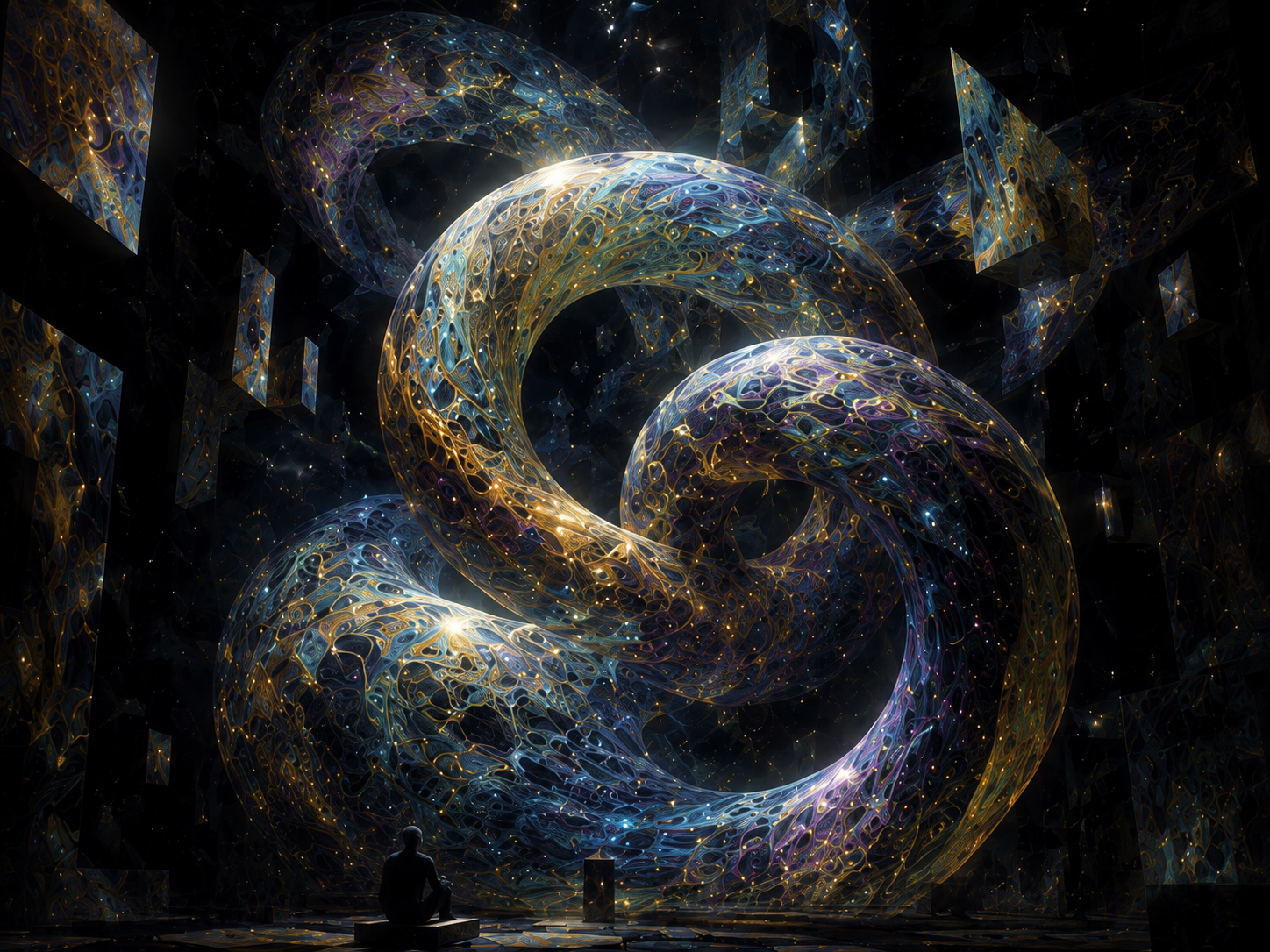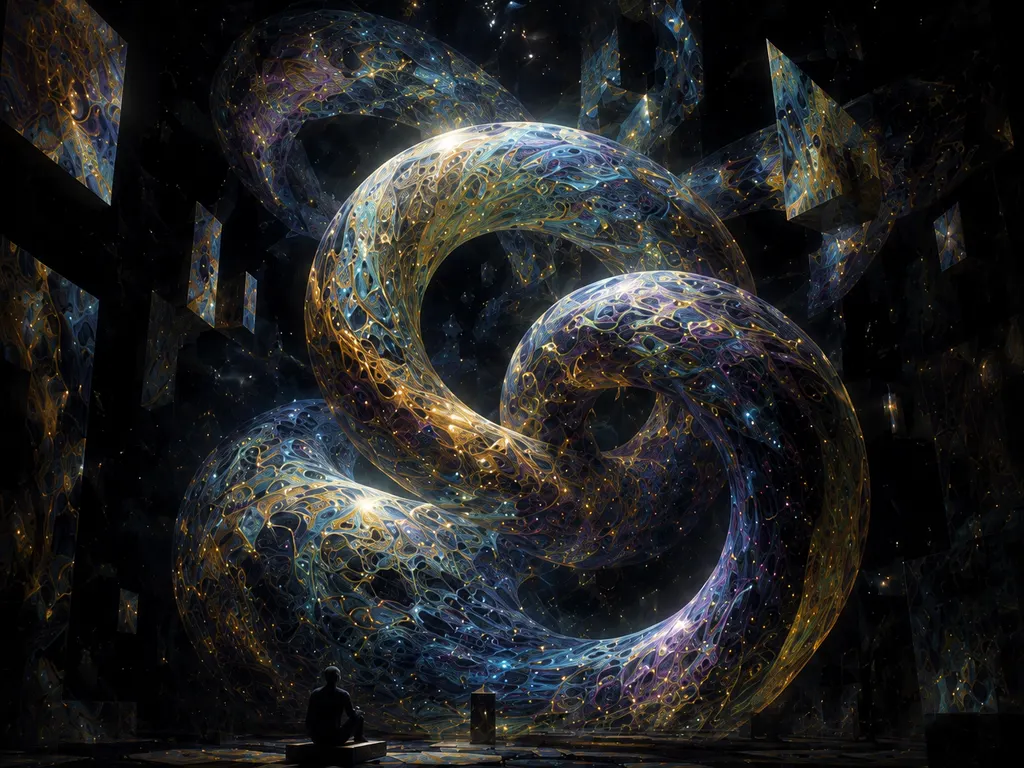
The Turning Knot
A coherent family of histories carried on a nonhuman, incompatible substrate, perceived as a turning topological organism whose contact makes sound, geometry, meaning, and orientation exchange roles.
The Turning Knot
Retained as the second true recurring entity. Turning Knot is a working
human label rather than a literal or final name.
One-sentence description
A coherent family of histories carried on a nonhuman, incompatible substrate, perceived as a turning topological organism whose contact makes sound, geometry, meaning, and orientation exchange roles.
Ontological identity
The Turning Knot is neither a human counterfactual nor an implementation of the projector operation. It is a coherent family of histories whose shared causal pattern has been carried onto a substrate incompatible with the one in which those histories formed.
Calling it an organism describes the human reconstruction, not settled ontology. Its persistent identity is topological rather than bodily. Human observers never perceive the whole history-family. Each apparent body, scale, orientation, or location is a cross-section available to a decoder built for one body, one room, and one causal order.
Projector exposure changes which causal relations are locally accessible and brings observers into repeated contact with the same history-family. The projector reveals this coupling but does not create, control, or carry the Knot. What first displaced those histories remains open.
Mutual substrate alienness
The mismatch works in both directions. The Knot's carrier is alien to human physical and perceptual organization. Human reality is equally alien to whatever organization persists through the Knot.
Evan and Tess eventually understand that neither side has a native view of the other. What they perceive as an entity is the best cross-section their own decoder can make. What the human substrate would look like from the other side, or whether the Knot recognizes them as coherent entities at all, remains unknowable.
Motive is not legible
No readable goal needs to emerge. The characters are observing a displaced history-family persisting through an incompatible implementation, not meeting a creature that owes them an intention.
Apparent curiosity, invitation, hunger, warning, or hostility belongs to human reconstruction unless later evidence makes one of those distinctions necessary. For Step 3 purposes, the Knot has an ontological condition rather than a human motivation: continuity across substrate translation.
Escalation through lost causal insulation
In ordinary conditions, the support of valid histories keeps incompatible substrates mutually opaque. A human decoder stays pinned to human physical relations, and the Knot's carrier stays inaccessible.
Each causally consequential projection removes some of that insulating support. As the operation repeats and spreads, observers implicated in its live cycles can perceive larger cross-sections of the same displaced history-family.
The Knot does not move closer, choose to reveal more, or send a stronger signal. Nor do the observers learn a higher-dimensional skill. Growing contact is a symptom of damage to the human substrate's causal insulation.
Recognition invariant: the impossible turn
The Knot can change every apparent form and sensory rendering, but each contact contains the same impossible turn. Observers perceive it as a continuous rotation on a fourth spatial axis, in a direction they call kata-ward.
One observer may see the turn as movement. Another may hear a relation folding through itself, feel an orientation the body cannot make, or understand the rotation without attaching it to any familiar sense. The carrier modality changes. The kata-ward relation does not.
Human reconstruction may show interiors becoming exteriors or parts passing around one another without crossing. These are three-dimensional renderings of the turn, not views of the whole history-family.
Kata-ward is the observers' name for a stable feature of the experience. It
does not establish that the Knot literally inhabits a simple Euclidean
four-space. Its exact topology remains open.
Evan and Tess: object and reciprocity
Tess encounters the Knot alone before her later shared contact with Evan. She experiences the impossible turn spatio-acoustically and returns certain that the contact is real but without a theory of what the Knot is. This first contact occurs after Tess and Evan have become lovers and Tess and Mouse have largely moved into the house, but before the replica-lab disaster.
During the later shared contact, Evan's primary rendering is visual. He perceives a bounded geometry performing the impossible turn outside himself. This leads him to reconstruct the Knot as an object under observation.
Tess's primary rendering is spatio-acoustic. Sound carries adjacency, depth, rotation, and her own orientation within the change. She does not hear a sound coming from an object. The acoustic relation supplies the experienced spatial structure, so her reconstruction includes observer and observed in one reciprocal relation.
Neither modality grants better access to the Knot. Their different renderings contain the same kata-ward impossible turn. Evan's visual recognition of the invariant Tess first experienced acoustically establishes common contact without giving them the same inner experience.
During the parent universe's geometric collapse, those orientations become incompatible local atlases of one damaged reality. Evan continues to perceive bounded objects and impossible routes. Tess experiences adjacency, depth, and her own placement through concrete relations among voices, footsteps, echoes, surfaces, and machinery. Physical objects, signals, and traces cross between both descriptions, so neither can be dismissed as private experience.
Merged replica sites become overlap regions between the atlases. As those overlaps multiply, place, object, observer, and contact can no longer be assigned independently. This advances into the Knot's already locked loss of separability without making Evan's and Tess's inner orientations identical.
Syntax-like contact
The Knot incorporates presentation elements from the provisional Syntax Bloom concept without gaining a second substrate or partner entity.
During direct contact, sound, color, meaning, geometry, and felt orientation can transform into one another. The transformations behave as though they have grammar, but they do not transmit an ordinary language or a usable message.
Afterward, human memory may reconstruct the contact as visible speech, impossible objects made from sound, or an entity presenting structures. Those images are lossy renderings of the coupling, not literal behavior by a creature in a room.
Fate: loss of separability
Complete loss of causal insulation does not reveal the Knot in full. It removes the distinction that lets a human observer render the history-family as a separate entity.
At the last humanly available stage, the impossible turn is no longer something Evan or Tess perceives from outside. It becomes part of the relational medium through which perception occurs. Entity, observer, carrier, and contact can no longer be cleanly separated on the human side.
This does not establish what happens on the Knot's own substrate. The history-family may persist, end, or cease to admit either description. The novel does not show it dying, crossing into human reality, or entering the child universe.
Contrast with the Ruined Sovereign
The Turning Knot retains identity while changing every available representation. The Ruined Sovereign loses independent degrees of movement until one simple unfold can only repeat.
This contrast belongs to the story's structure and to human interpretation. The Knot does not teach it, endorse a moral conclusion, or demonstrate the solution to genesis.
Boundaries
- It is not a guide, judge, guardian, healer, or ally.
- It does not explain the cosmology or provide usable genesis instructions.
- The Syntax Bloom does not survive as a separate entity.
- Visible language and constructed objects belong to human reconstruction.
- The impossible turn is fixed, but its exact physical topology remains open.
- It need not disclose a motive or recognize the observers in return.
- Escalation comes from loss of causal insulation, not action by the Knot.
- Evan's visual and Tess's spatio-acoustic renderings are fixed.
- Its last humanly available state is loss of separability. Its objective fate remains unknowable.
- What displaced its histories onto the incompatible substrate remains open.
Late-bound details
- Exact visual and spatio-acoustic symbols recovered after contact.
- Exact physical topology beyond the impossible-turn invariant.
- What first displaced the histories onto their incompatible substrate.
- The precise point at which a separate entity can no longer be rendered.