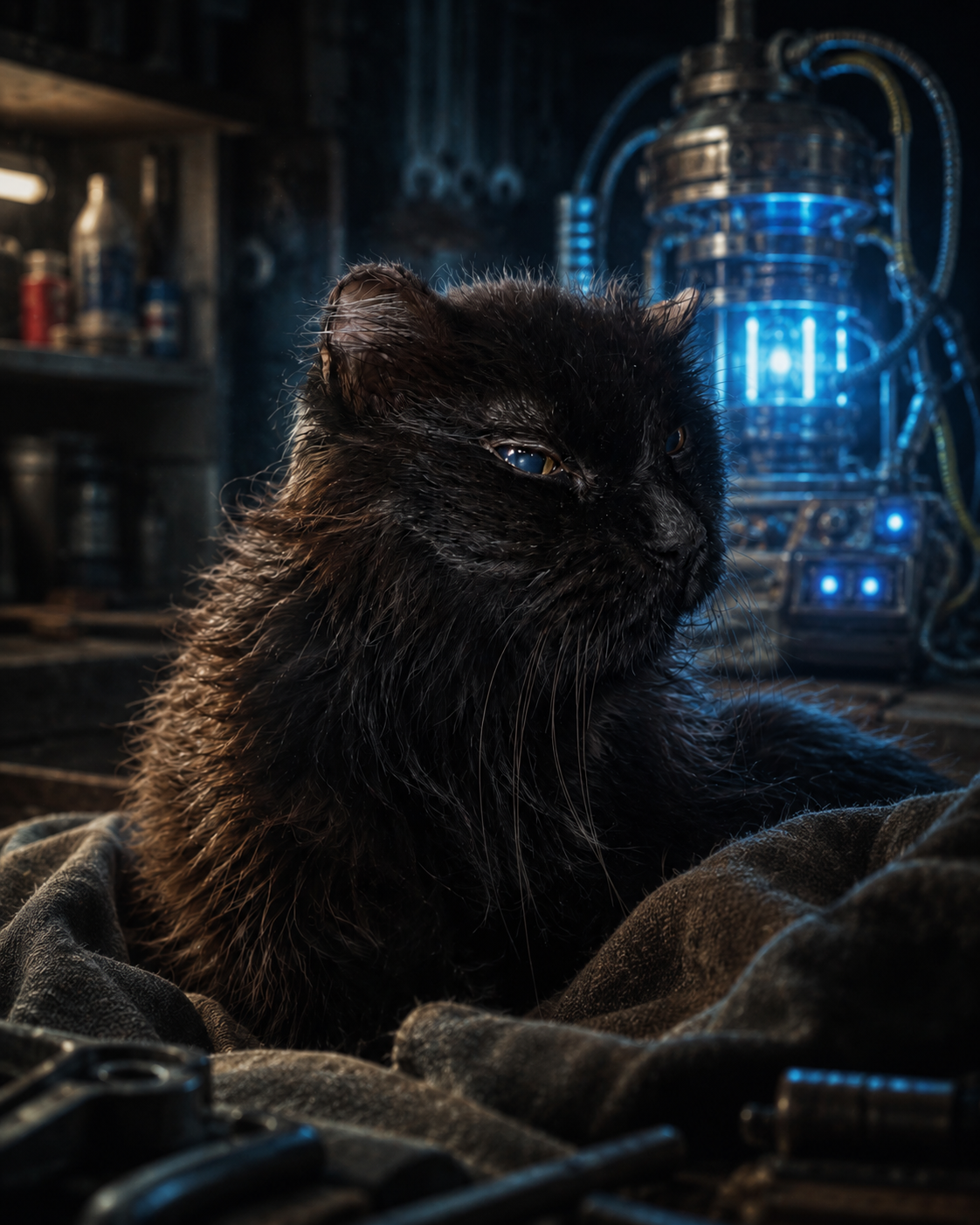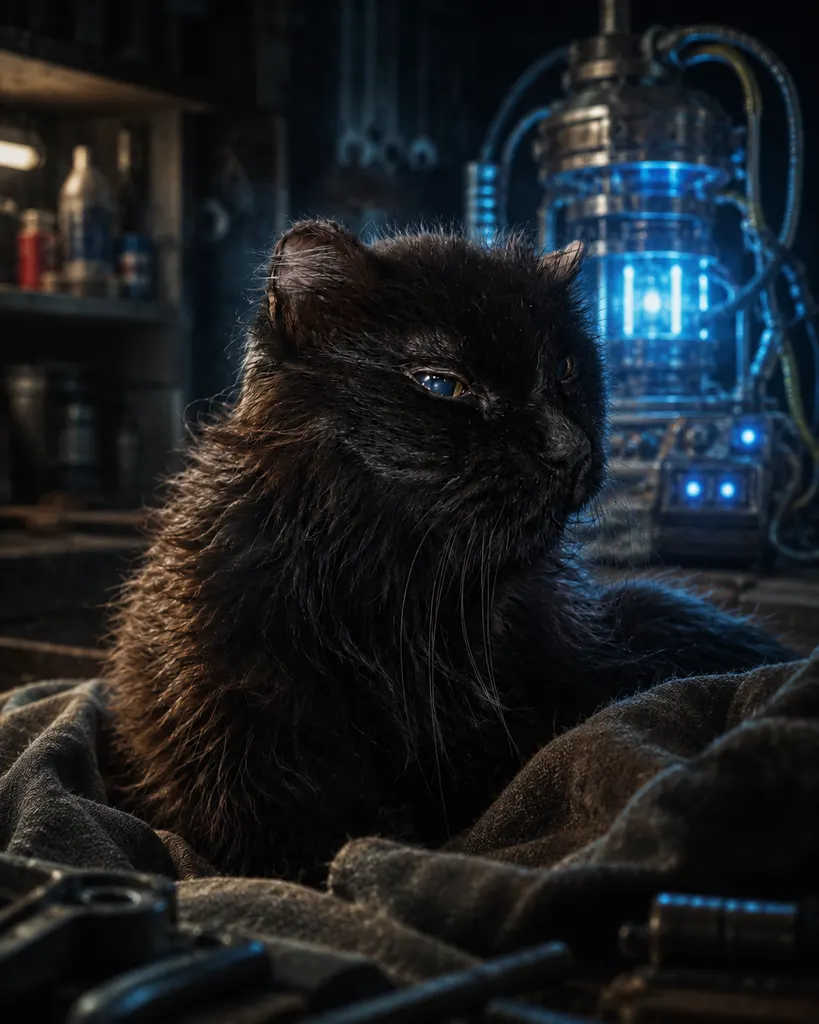
Mouse
Mouse is Tess's tiny, elderly, fearlessly curious cat, who watches humans, animals, and impossible events with the same calm attention.
Mouse
Mouse's exact terminal action stays late-bound until the final chapter or two are outlined.
One-sentence description
Mouse is Tess's tiny, elderly, fearlessly curious cat, who watches humans, animals, and impossible events with the same calm attention.
Identity and appearance
- Mouse is female and seventeen years old during the main story.
- She is a long-haired black-and-brown cat. Her aging coat can look scraggly enough to hide how small she is.
- She weighs about five pounds.
- Before Tess adopted her, frostbite destroyed the tips of both ears. Their shortened outline looks vaguely mouse-like, which is the basis of her name.
- Her exact breed and coat pattern remain open.
Early life and adoption
Mouse is born in the loft of a cabin in Fairbanks. Her mother is gone before Mouse retains a lasting memory of her, and the cabin's owner never knows Mouse exists.
During her first seven years, Mouse bops from one temporary home to another and spends a prolonged stretch living in the woods around Ester. By the time she reaches the shelter, frostbite has destroyed the tips of both ears.
Tess adopts Mouse from the shelter when Mouse is seven. Tess then moves with her to the Pacific Northwest. Mouse is seventeen during the main story, so they have lived together for about ten years. The exact temporary homes, outdoor sequence, shelter history, adoption scene, and timing of the move remain open.
Temperament
Mouse is intensely curious about humans and other animals. She is afraid of nothing. When something strange happens, she stays close enough to watch it calmly.
Mouse is affectionate in her own way with the people she considers hers. She is interested in everyone, but her interest is stoic. She often watches from the arm of a chair or the corner of the workbench instead of demanding the center of the room.
This behavior must be established during ordinary household life. Her later calm around projector contact should feel like the same cat responding to something stranger than usual, not a new supernatural ability.
Her age and size remain physically real. They do not make her timid, symbolic, or helpless, and her fearlessness does not make her invulnerable.
Relationship with Tess
Tess adopts Mouse from the shelter after the frostbite injury and takes her to the Pacific Northwest. Their ten years together make Tess the first durable home in Mouse's life.
Mouse belongs to Tess's small, ordinary life before the project. She later moves into Evan and Ruth's house with Tess when late research sessions become overnight stays in the spare room. Tess initially carries Mouse's supplies back and forth. Ruth tells her to leave them, and the house gradually becomes their home. Their bond needs to exist on the page before Mouse carries any cosmic function.
Mouse follows Tess anywhere. She travels curled up in a little bag or perched on Tess's shoulder. This is an established habit rather than a convenience introduced during the terminal corridor.
Place in Evan and Ruth's house
Mouse becomes part of the household rather than appearing only around contact or catastrophe. Ruth becomes her preferred resting companion. Mouse frequently looks up at Ruth and meows once to get her attention.
The single meow is an ordinary, repeatable request for attention. It gives Mouse a small way to address Ruth without turning the cat into a commentator on Ruth's condition.
Once Tess and Mouse live in the house, Evan becomes one of Mouse's people. She is interested in him without fuss and often observes him from the corner of the workbench or the arm of a nearby chair.
Those ordinary habits should establish the paths, people, voices, and places Mouse recognizes later. The ending works because she knows a shared household, not because she understands either human account of the damaged world.
Projector-linked contact
Mouse is unusually comfortable around people undergoing contact. She is drawn toward them and appears at home within the perturbation.
This remains suggestive. Her ordinary fearlessness and curiosity already explain why she would watch calmly. The story does not confirm that she senses the projector, sees an entity, understands a new geometry, or has privileged access to the causal substrate.
Local catastrophe
Mouse survives the compound collapse and explosion miraculously unscathed. Her survival is striking and unexplained, but it does not prove that the operation protected or selected her.
When Evan returns to find Ruth dead, Tess alive and frightened by her possible role in the carrier, the neighborhood ruined, and Mouse unharmed, her survival is one unexplained fact in the aftermath. Evan recognizes his repeated loop of converting helplessness into work, turns toward Tess, and stays with her. Mouse neither causes that recognition nor explains it.
Ending function
During loss of separability, Mouse moves through a badly perturbed region and settles somewhere Evan and Tess can both identify from their incompatible orientations. She gives them their last shared external fact. The exact movement, route, and place remain late-bound.
Mouse establishes that Evan and Tess still occupy one causal neighborhood. She does not reveal what either will choose. She does not cause, permit, measure, or solve the terminal act.
After Evan and Tess make their independent choices and those choices meet, the final portion of the genesis-operation chapter shifts to Mouse's literal viewpoint. This is the novel's only cat viewpoint.
Viewpoint rules
- Mouse remains an animal. She understands familiar people, voices, cadence, attention, movement, scent, routine, comfort, and threat.
- She registers light, sound, pressure, motion, bodily response, and orientation. She does not understand the projector, the terminal choice, genesis, or the child universe.
- Evan and Tess's final words may appear verbatim for the reader. Mouse hears familiar voices and reacts to how the humans speak and move, not to the semantic or cosmological meaning.
- Her attention follows curiosity and immediate sensation. It cannot become hidden human narration written in simplified language.
- She physically bridges Evan's visual context and Tess's spatio-acoustic context without making either one authoritative.
Arc landmarks
- Ordinary life: Mouse is already an old, tiny, fearless observer in Tess's life after an unstable first seven years in Alaska. She follows Tess anywhere, curled up in a little bag or perched on her shoulder.
- Domestic arrival: She moves into Evan and Ruth's house with Tess, chooses Ruth as her preferred resting companion, and frequently looks up at Ruth and meows once for her attention.
- Contact: She watches people undergoing projector-linked contact with the same calm curiosity she brings to other strange behavior.
- Catastrophe: She survives the local collapse unscathed.
- Last shared reference: Her movement through broken geometry gives Evan and Tess one final fact they can both identify.
- Final viewpoint: After their independent choices meet, Mouse hears their final words without understanding them and senses their response to the incoming Big Bang.
- Child-side echo: The later clinical observer compares his lost understanding to seeing the end or beginning of time from the perspective of a cat. This does not mean Mouse crossed genesis.
Boundaries
- Mouse is not a guide, oracle, proof, magical key, mechanical trigger, solver, or terminal chooser.
- She does not explain entity contact or authenticate the cosmology.
- Her calmness is not proof of supernatural perception.
- Her survival does not establish protection by the operation.
- She does not cross into the child universe as an intact animal.
- Her exact terminal action and sensory execution remain late-bound.